You’re Not Falling Behind. You’re Being Sold a Treadmill.
There’s a business model built on your restlessness.


Every time you abandon a tool for a newer one, someone makes money. The lifetime deal sites. The YouTube reviewers with affiliate links. The SaaS companies offering “migration assistance” from the thing they told you was revolutionary eighteen months ago. The influencers whose entire content calendar depends on there always being something new to breathlessly announce.
This isn’t a conspiracy theory. It’s just economics. The AI and automation industry has discovered something powerful: they make more money when you switch than when you stay.
This is Ignorance Arbitrage — the practice of profiting from keeping you in a constant state of not-quite-understanding, not-quite-finished, not-quite-sure-if-there’s-something-better. As long as you’re uncertain, you’re a customer. As long as you’re chasing, you’re clicking. As long as you believe the next tool might be the one, you’ll keep paying for the privilege of finding out.
The cruelest part? The people selling you this cycle aren’t villains. Most of them genuinely believe in what they’re recommending. They’re just caught in the same system you are — where “new” is the only content that gets engagement, and “I’m still using the same thing I recommended two years ago” doesn’t get views.
But you’re the one paying the price.
The Symptoms Nobody Talks About
Here’s what constant tool-switching actually costs you, and I’m not talking about subscription fees.
You never ship anything. Every migration is a reset. You spend three weeks learning the new interface, rebuilding your workflows, watching tutorial videos, and by the time you’re productive again, something newer has launched. The project you were supposed to finish? Still unfinished. The system you were supposed to build? Still theoretical. You have seventeen half-built automations across four platforms and zero that actually run.
You have no portfolio. After two years of “working with AI,” you can’t point to a single system that’s been running reliably for six months. Not because you’re incompetent — because you never stopped long enough to build something that compounds. Your GitHub is a graveyard of abandoned experiments. Your project management tool (whichever one you’re using this month) is full of optimistic start dates and no end dates.
You’re bleeding money you don’t track. The $29/month here, the $49/month there, the annual plan you forgot to cancel, the lifetime deal that was “too good to pass up” for software you used twice. I’ve seen people spending $400/month on tools with overlapping functionality because they never fully committed to any of them. That’s not a tech stack. That’s a subscription graveyard with a pulse.
Your brain is exhausted. This is the one nobody measures, but it might be the most expensive. Every new tool requires cognitive load — learning the interface, understanding the logic, remembering which automations live where. When you’re spread across six platforms, you’re not thinking about your actual work. You’re thinking about your tools. The mental overhead of “wait, which one does that again?” is a tax you pay constantly without realizing it.
And here’s the really uncomfortable question: Is this you?
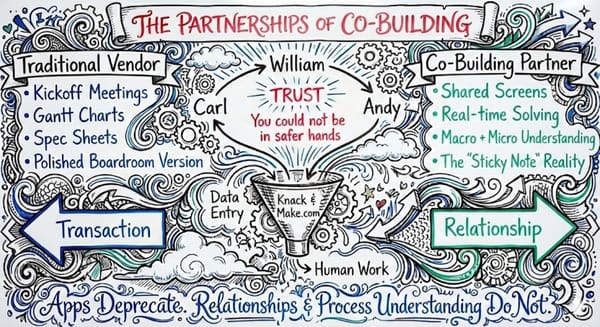
Because I’ve conducted over 700 co-building sessions with business owners, and I can tell you this pattern doesn’t discriminate. Smart people. Experienced people. People who’ve built real businesses. They get caught in this cycle not because they’re gullible, but because they’re curious and ambitious and genuinely trying to stay current.
The tool-chasing doesn’t feel like a problem while you’re doing it. It feels like learning. It feels like due diligence. It feels responsible, even — wouldn’t it be worse to miss something important?
But if you’re honest with yourself, when’s the last time you finished building something and let it run?
The 90-Day App Funeral Rule
I want to give you a simple test. Before you adopt any new tool, ask yourself this:
Can I completely kill the old tool within 90 days?
Not “pause.” Not “keep around just in case.” Not “use for this one thing while the new tool handles everything else.” Kill. Cancel the subscription. Delete the account. Hold a small, dignified funeral and move on.
If the answer is no — if adopting the new tool means you’ll be running both for the foreseeable future — you’re not upgrading. You’re stacking. And stacking is how you end up with seventeen subscriptions, four half-built systems, and a growing sense that you’re somehow failing at technology despite spending more on it than ever.
The 90-Day App Funeral Rule does two things. First, it forces you to be honest about whether the new tool actually replaces the old one or just adds complexity. Second, it builds in a deadline. If you can’t migrate fully in 90 days, something’s wrong — either with the new tool, your commitment to it, or the decision to switch in the first place.
Most tools fail this test. Not because they’re bad, but because they don’t actually solve a problem you have. They solve a problem the demo video convinced you that you have. There’s a difference.
What Boring Actually Looks Like
Let me tell you about Julia. (Not her real name, but a real client.)
Julia was drowning in email. Not the important kind — the promotional kind. Newsletters she’d signed up for and forgotten about. Software update notifications. Forum digests. Social media alerts. Every day, she’d open her inbox to 40+ messages that weren’t urgent but still demanded attention. Delete, delete, delete, occasionally click through, delete, delete.
She’d tried filters. She’d tried inbox zero methods. She’d tried different tools, each promising to solve the problem. Each adding its own complexity. None of them stuck.
Here’s what we built instead: a Make.com automation that runs once a day. It pulls everything from her Promotions, Social, Updates, and Forums Gmail labels, summarizes the contents using AI, and sends her one email with the highlights. Then it archives everything.
That’s it. That’s the whole system.
Now Julia reads one email instead of managing forty. If a newsletter isn’t worth keeping, she clicks one link to unsubscribe — right there in the summary, no hunting for the tiny unsubscribe text at the bottom of some marketing email. The automation runs at 3 PM every day. She hasn’t touched it since we built it three weeks ago.
The first thing she says when we get on a call now?
“I love that summary email you built for me!”
This system isn’t impressive to describe. It won’t get featured on ProductHunt. Nobody’s writing breathless LinkedIn posts about daily email summaries. But it works. It keeps working. And Julia isn’t spending mental energy on it anymore because there’s nothing to spend mental energy on.
That’s what boring looks like. Not a system that impresses people — a system that disappears because it just works.
The Permission You Might Need
If you recognized yourself in the first half of this article, I want to offer you something: permission to stop.
You can stop chasing. You can stop watching the launch videos. You can stop believing that your current tools are somehow inadequate just because newer ones exist. You can let the early adopters beta test everything and check back in two years to see what’s still standing.
The tools you have probably work fine. The problem isn’t your stack — it’s that you never stay long enough to build something that compounds.
Pick something. Build something. Let it run. Hold a funeral for the tools that didn’t make the cut and stop paying for their ghost subscriptions.
The Ignorance Arbitrage economy wants you restless. It profits when you’re uncertain, when you’re chasing, when you’re perpetually three weeks into a project and zero weeks into finishing one.
But you don’t have to play that game.
Boring tools that actually run are worth more than exciting tools you’re still figuring out. A finished system beats a perfect system every time. And steady and safe — the stuff that doesn’t make for breathless content — is the only foundation that lets your work compound instead of reset.
The next shiny thing will launch tomorrow. It always does.
You could chase it. Or you could finish something instead.
Andy O’Neil helps business owners build AI systems that don’t make them want to throw their laptop into traffic. He shares what he’s learning in his newsletter, builds automations and AI stuff on YouTube, and has conducted 700+ co-building sessions. Connect on LinkedIn if you want more of this…whatever “this” is.