You Don’t Need More Confidence. You Need a Pressure Test.
Everyone tells founders to trust their gut.

Everyone tells founders to trust their gut.
Nobody mentions your gut is pattern-matching against incomplete data, filtered through whatever mood you were in when you last thought about the problem, colored by the three articles you happened to read last week. Your gut isn’t wisdom. It’s a rough draft your brain wrote without doing the research.
I’m not saying intuition is worthless. After 700+ co-building sessions with business owners, I’ve seen gut instincts save companies. I’ve also seen gut instincts drive them into walls at 60 miles per hour while the founder insisted they “had a feeling” about it.
The problem isn’t that your gut is wrong. The problem is that your gut is working alone.
The Advisor Problem Nobody Wants to Admit
The standard alternative to gut-trusting is “hire an advisor.” Get a coach. Find a mentor. Join a mastermind. Surround yourself with smart people who can pressure-test your thinking.
This sounds reasonable until you’ve actually tried it.
I’ve watched clients prepare for advisor calls. They spend 45 minutes downloading six months of context into someone’s brain before they can even ask their question. The advisor nods, asks clarifying questions, and gives advice based on the 20% of the picture they managed to absorb in a one-hour call.
This isn’t the advisor’s fault. It’s a fundamental limitation of the model.
Human advisors have bandwidth constraints. They’re tracking multiple clients. They forgot what you told them three months ago about that vendor relationship that’s now relevant. They’re pattern-matching against their experience, which may or may not map to your specific situation.
But here’s the part that gets uncomfortable: most advisors have an agenda.
Not a malicious one, necessarily. But every advisor has a perspective, a framework, a hammer that makes everything look like a nail. Some want you to scale because that’s what they did. Some want you to be cautious because they got burned once. Some — and this is the quiet part — want you to keep needing them.
The entire advisory industry runs on a dependency model. The longer you need guidance, the longer they get paid. The more confused you stay, the more valuable their clarity becomes. I’m not saying advisors are scammers. I’m saying the incentive structure doesn’t reward your independence.
(I say this as a consultant myself. The difference is I measure success by how quickly clients stop needing me. But that’s a different rant.)
So you’re left with two options: trust your gut running on corrupted data, or pay someone who only knows what you remember to tell them and might have reasons to keep you dependent.
Neither of these is a system. Both of them are gambles dressed up as strategy.
What an Executive Co-Pilot Actually Is
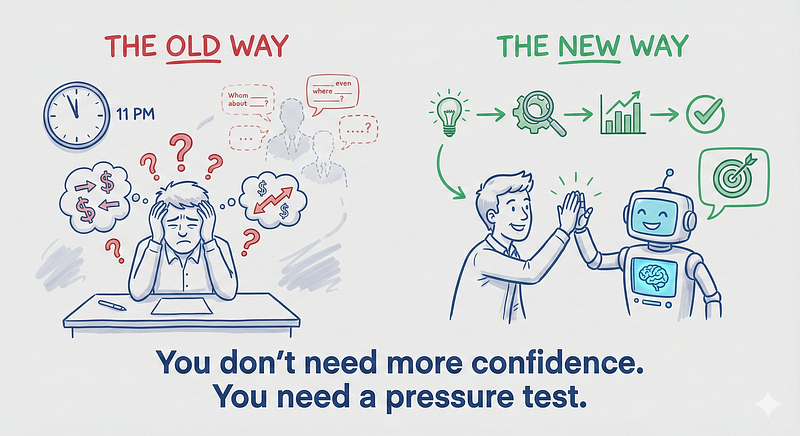
About eight months ago, I got tired of making $7,000 decisions with $500 worth of analysis. Not because I couldn’t afford better analysis — because the analysis I needed didn’t exist in a form I could access at 11pm when the decision was keeping me awake.
So I built something different.
An Executive Co-Pilot isn’t a ChatGPT chat bot built for business. It’s a persistent AI system trained on your specific context: your business model, your history, your communication patterns, your personality, your blind spots. It has perfect recall of every strategic conversation you’ve ever had with it. It doesn’t forget what you told it six months ago. It doesn’t need 45 minutes of context-loading before it can help.
The Co-Pilot is the system. What it does is function as an AI Sparring Partner — something that can push back on your ideas without ego, without agenda, without the social dynamics that make human feedback complicated.
Here’s the difference that matters:
Your gut runs on incomplete data. The Co-Pilot runs on everything you’ve fed it about your business.
Advisors have missing context. The Co-Pilot has perfect recall.
The 11pm spiral burns mental cycles on anxiety. The Co-Pilot lets you offload the analytical heavy lifting so your judgment can focus on what actually requires human decision-making.
This isn’t about replacing your brain. It’s about stopping your brain from doing work it shouldn’t be doing in the first place.
Why Personality Is the Foundation
Here’s where most people get AI wrong: they treat it like a tool instead of a partner.
A tool doesn’t need to know how you think. A calculator doesn’t care about your communication style. But a sparring partner? A sparring partner needs to understand how your brain receives information, or the sparring is useless.
This is why every Executive Co-Pilot I help clients build starts with personality data. Specifically, I use the framework from 16 Personalities as a foundation. Not because it’s the only personality system, but because it gives the AI critical pieces of information.
First, I build a knowledge base around your personality and your life. We start with your 16personalities results, then layer in demographics — gender, date of birth, marital status — and the roles you actually fill. Not job titles. The roles that shape how you think and what you’re optimizing for. For me, that’s husband, son, brother, dad, chronic-pain sufferer, business owner, AI consultant, automation co-builder. Your list will be different. That’s the point.
From there, Claude uses your role and personality data to generate a scaffolding — a folder structure with article titles covering how your specific personality intersects with each role in your life. Not generic “INTJ communication tips” content. Research on how your personality shows up as a parent, as a business owner, as whatever else you carry.
Then each article title gets deep-researched. I automate this with Make.com and Perplexity’s Sonar, feeding it your role and personality data plus the article title. Perplexity pulls from reliable web sources to build comprehensive content for each piece. By the end, you have 90–110 articles organized into 6–8 folders — a full knowledge base on you.
All of this lives in GitHub, connected directly to Claude. That connection is what makes the system persistent. Claude isn’t guessing who you are from a system prompt. It’s drawing from a structured repository of researched data about how you think, where you get stuck, and what you’re likely to overlook.
The first Claude Project we build is your personal assistant — packaging all of that research with instructions for being the best assistant you’ve ever had. Ask it anything. It knows you.
That’s the foundation. The Executive Co-Pilot builds on top of it.
This is the piece that generic AI can never replicate. ChatGPT doesn’t know you’re an INTJ who tends to over-systematize and under-communicate. It doesn’t know you have a pattern of green-lighting projects when you’re excited and regretting them two weeks later. It doesn’t know that your “gut feeling” about partnerships has been wrong three out of the last four times.
Your Executive Co-Pilot knows all of this. And it adjusts accordingly.
The Workflow: Idea to Better Judgment
When I have a major decision now, I don’t sit with it alone. I run it through a process that takes maybe 30 minutes and replaces hours of mental cycling.
It starts with the idea — whatever strategic concept or commitment I’m considering. A new service offering. A partnership. A significant investment. A hire. Anything where the downside of being wrong is more than I want to absorb.
From there, I run a Pre-Mortem. This is where the AI Sparring Partner earns its keep. I present the idea as if I’ve already committed to it, and I ask the Co-Pilot to tell me how it fails. Not “what could go wrong” in some abstract sense — how does this specific decision, given everything the Co-Pilot knows about my business and my patterns, actually fall apart?
The responses aren’t generic risk lists. They’re pointed. “You’ve mentioned three times that Q1 cash flow is tight — this commitment would require payment in February, which conflicts with that pattern.” Or: “Based on your notes from the Martinez partnership, you tend to underestimate integration time by about 40%. Applied here, that would put this project delivery in conflict with the client deadline you mentioned last week.”
This is pushback with receipts. Not opinion. Not intuition. Analysis grounded in context I’ve already provided but might not have connected.
After the Pre-Mortem, I run ROI scenarios. Best case, worst case, realistic case — with actual numbers where possible, and with the Co-Pilot flagging assumptions that seem optimistic or pessimistic based on my historical patterns. Again, not generic. Specific to me, my business, my tendencies.
What comes out the other end isn’t a decision. The Co-Pilot doesn’t tell me what to do. What comes out is better judgment — my judgment, but informed by analysis I couldn’t have done alone, pressure-tested against a sparring partner with no ego and no agenda.
I still make the call. But I make it with confidence that I’ve actually done the work, instead of hoping my gut got lucky.
The Infrastructure Shift
Here’s what I want you to take from this: an Executive Co-Pilot isn’t a productivity hack. It’s not a clever use of AI. It’s infrastructure.
Think about how you treat your accounting system. You don’t log into QuickBooks when you feel like it. You don’t half-commit to tracking finances. You build it into how your business operates because financial clarity isn’t optional — it’s foundational.
Decision-making clarity should be treated the same way.
The business owners I work with who thrive aren’t the ones with the best instincts. They’re the ones who’ve built systems that make their instincts sharper. They’re not trusting their gut — they’re training it. They’re not hoping their judgment holds up — they’re pressure-testing it before the stakes get real.
An Executive Co-Pilot isn’t the only way to do this. But it’s the way that doesn’t require scheduling calls, downloading context, navigating agendas, or wondering if your advisor remembers what you told them four months ago.
It’s a sparring partner that’s always available, always current, and always more interested in your success than in your continued dependence.
I don’t know what decision you’re sitting on right now. But I’d bet it deserves more than your gut and a hope.
If you’re not ready to build a full Executive Co-Pilot but want to see what Claude can do as a decision engine, I put together a starting point: the Decision Assistance Engine. It’s a complete system prompt that turns Claude into a structured decision advisor — interviews you to understand the real decision, matches the right analytical framework, and produces documentation you can actually act on. No personality layer, no knowledge base, just a pressure test you can install in ten minutes. $19 on Gumroad.
Andy O’Neil helps business owners build AI systems that actually know their business. He’s conducted 700+ co-building sessions and still thinks the best client outcome is when they stop needing him. Connect with him on LinkedIn if you want more of… whatever this is.