The Cold Start Tax: What Losing Your Place Really Costs
Every time you open a new chat with an AI, you pay a hidden price. Not money—though we'll get to those numbers. You pay in time spent explaining things again. You pay in lost understanding that took days to build. The AI you talked to yesterday? It forgot everything. You're back to square one.

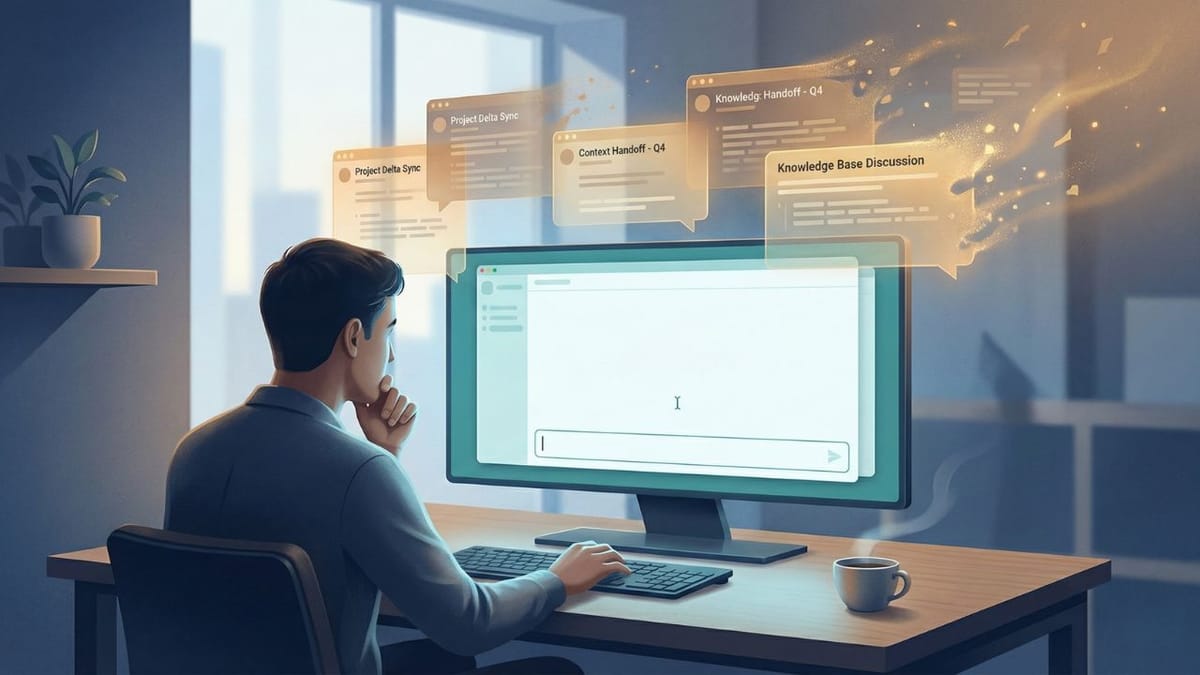
Every time you open a new chat with an AI, you pay a hidden price. Not money—though we'll get to those numbers. You pay in time spent explaining things again. You pay in lost understanding that took days to build. The AI you talked to yesterday? It forgot everything. You're back to square one.
Your own brain fights a similar battle every day. You check your email. You glance at Slack. You jump back to that spreadsheet. Each time, your brain needs about 23 minutes to get back to deep thinking. That's not a guess—scientists measured it.
Here's what this really costs: Office workers lose about 5 weeks every year just from switching between tasks. AI tools work 39% worse when conversations stretch across multiple messages. Together, these problems drain somewhere between $450 and $588 billion from the U.S. economy each year. That's real money disappearing because we keep losing our place.
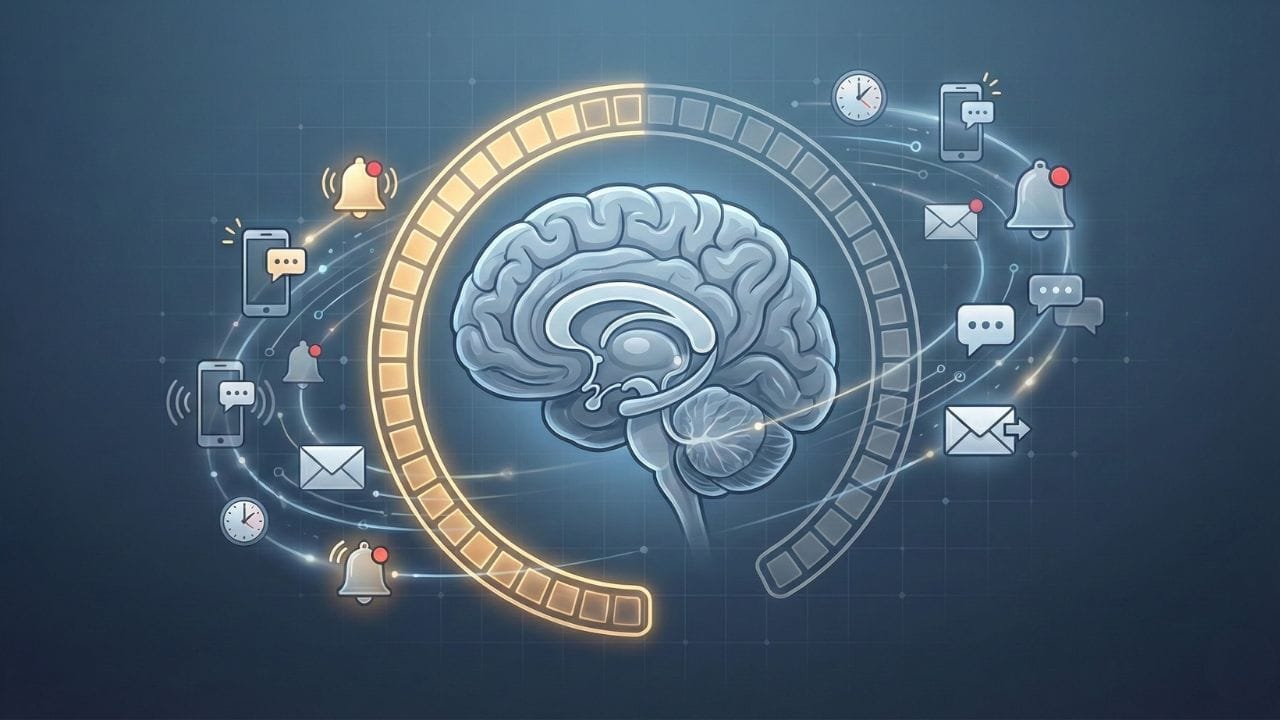
Why 23 Minutes Matters
Gloria Mark is a professor at UC Irvine. She wanted to know what happens when people get interrupted at work. What she found became one of the most famous facts in workplace research: 23 minutes and 15 seconds.
That's how long it takes your brain to fully focus again after someone breaks your concentration. Not to feel like you're working—to actually work as well as you were before.
"Your brain treats unfinished work like a browser tab that's still running in the background—using up energy even when you're not looking at it."
Here's the scary part. Mark tracked attention spans over many years. In 2004, people could focus on one screen for about 2.5 minutes. By 2021, that dropped to just 47 seconds. We're getting much worse at paying attention, not better.
Why does switching tasks hurt so much? A researcher named Sophie Leroy figured it out. She calls it "attention residue." When you switch before finishing something, part of your brain stays stuck on the old task. It's like mental clutter that doesn't get cleaned up.
Leroy's studies showed something important. People with attention residue "did not process information carefully, did not notice errors and, when asked to make a decision based on recalled information, were less likely to identify the optimal solution." In plain English: leftover thoughts from your last task make your current work worse.
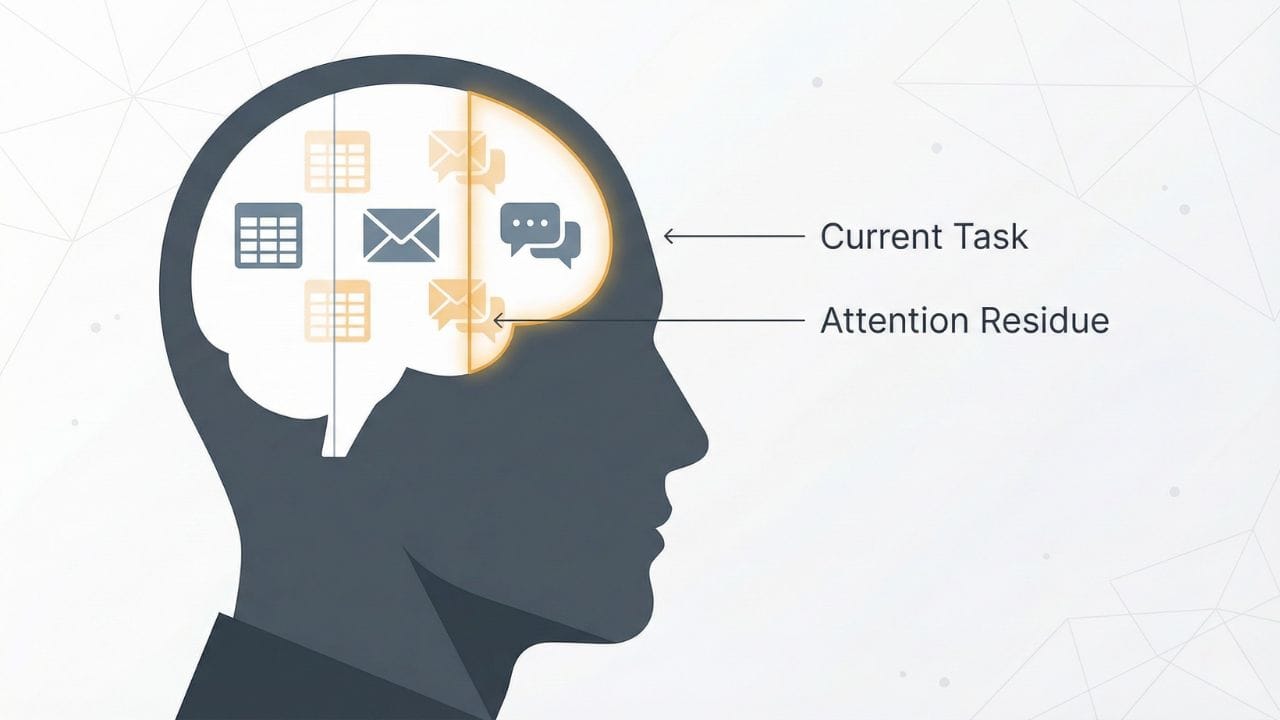
The American Psychological Association looked at the research and put numbers on it. Switching tasks can cut your output by up to 40%. Each switch makes your brain do two things: decide what you're trying to do now, and turn off the rules from your last task while turning on new ones. These steps aren't instant. They add up.
So how often do we switch? One study followed 137 workers at big companies. The answer: 1,200 times per day.
Think about that. Twelve hundred times a day, you jump between apps and windows. If each switch only cost you 10 seconds of real work—and it probably costs more—you'd lose over 3 hours daily. The actual finding was worse: workers spend about 4 hours every week just getting their bearings after switching between apps.
| What They Found | The Numbers | Who Found It |
|---|---|---|
| Time to fully refocus | 23 min 15 sec | Gloria Mark, UC Irvine |
| Work lost from task-switching | Up to 40% | American Psychological Association |
| Typical attention span on screens | 47 seconds | Gloria Mark |
| App switches per day | ~1,200 | Harvard Business Review |
| Hours lost weekly to app switching | 4 hours | Harvard Business Review |
| Work weeks lost each year | ~5 weeks | Harvard Business Review |
Here's the bottom line: about 5 weeks per year—9% of your work time—vanishes to switching between tasks. That's not time spent working on different things. That's pure waste. The mental version of commuting to work, except you do it hundreds of times a day without leaving your chair.
AI Has the Same Problem
You might think AI helpers wouldn't have this problem. They don't get tired. They don't have leftover thoughts cluttering their minds. They process information incredibly fast.
But they have a different version of the same disease. It's called the cold start problem. Every new chat starts with zero knowledge of what you talked about before. That great conversation yesterday where the AI finally understood your project? Gone. You're explaining everything from scratch.
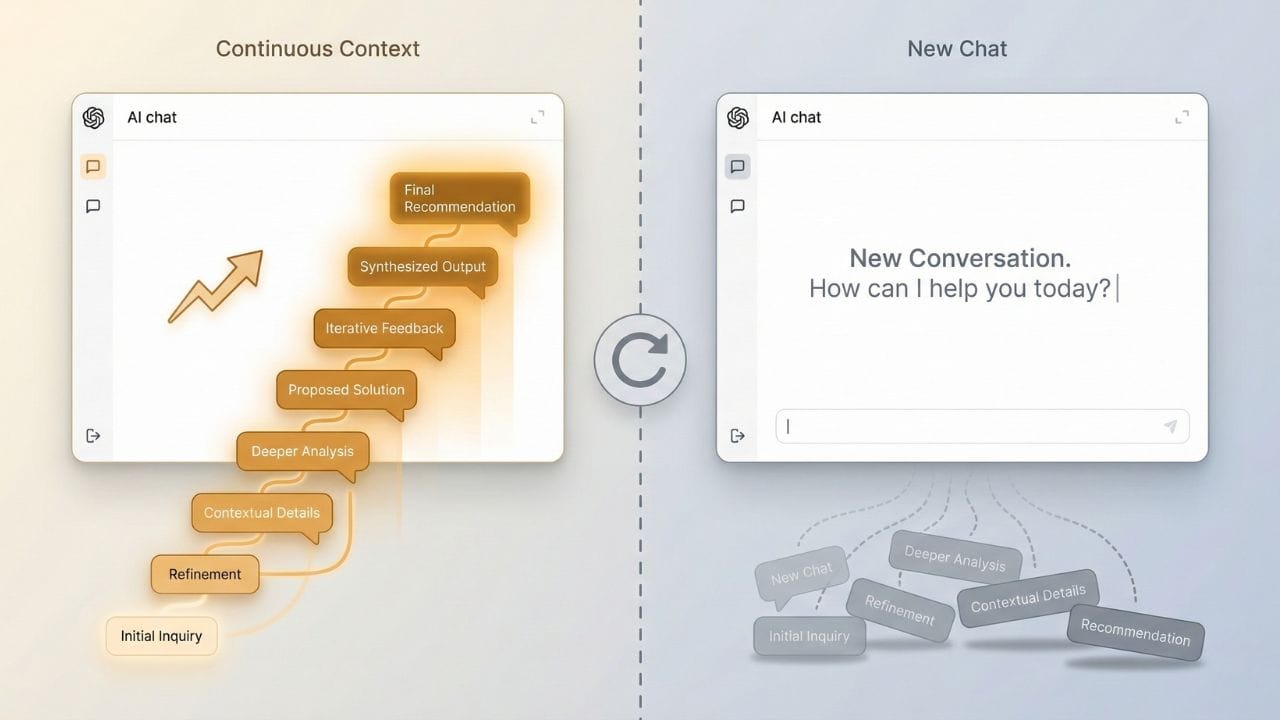
"When AI takes a wrong turn in conversation, it gets lost and doesn't recover."
Researchers at Microsoft and Salesforce measured exactly how bad this gets. In May 2025, they studied over 200,000 conversations across more than 15 different AI models. Their finding: AI performs 39% worse when information comes across multiple messages instead of all at once.
When you give AI everything it needs in one message, it gets things right about 90% of the time. Spread that same information across a conversation, and accuracy drops to 65%. That's a 25-point drop just from breaking things into pieces.
The surprise? This wasn't just a problem for cheaper AI models. Claude, Gemini, and GPT-4 all lost 30-40% accuracy in longer conversations. The best models struggled just as much as simpler ones. Why? AI makes early guesses and commits to answers too quickly. When later messages add new information, the AI struggles to change course.
Another research team studied what they called "Context Rot." They tested 18 AI models and found that "models do not use their context uniformly; instead, their performance grows increasingly unreliable as input length grows." Even on super simple tasks—like just repeating words—AI started making up words that weren't even in the conversation as chats got longer.
This isn't a small inconvenience. It changes how useful these tools can be. Complex projects that take multiple sessions. Analysis that builds over time. Understanding that develops through long conversations. All of these hit the cold start tax every time a chat ends.
User surveys confirm the frustration. Half of all users feel frustrated with chatbot experiences that go poorly. 62% give up on tools after just one bad interaction. But systems that remember past conversations show 300% higher satisfaction. The gap between AI that forgets and AI that remembers isn't small—it's huge.
Too Many Tools Make It Worse
The switching problem doesn't exist by itself. It multiplies with every tool you use.
A survey of nearly 5,000 workers found that the average office worker now uses 11 apps every day. Back in 2019, it was only 6. That's an 83% increase in just four years.
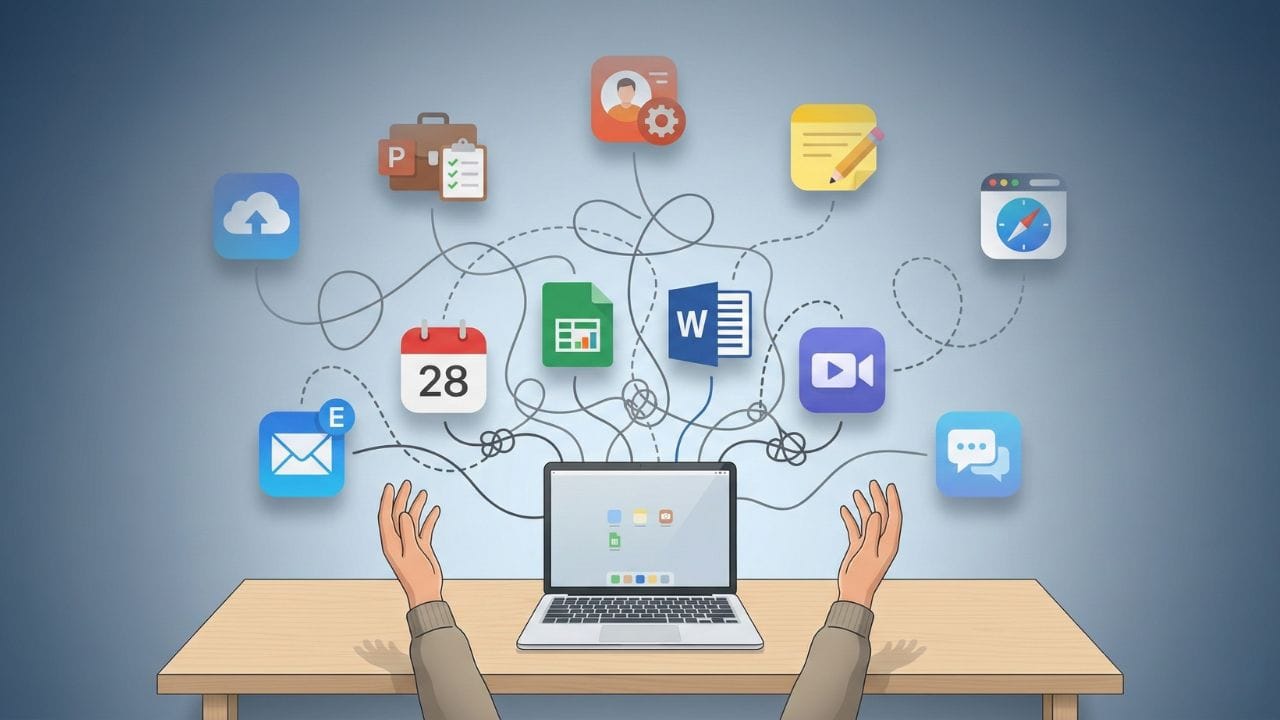
But 11 apps is just one person. Whole companies are much worse. Research found that large companies manage an average of 367 different software programs. Each one stores different information. Each one has its own way of searching. Each one creates another wall between you and what you need.
"It's like hiring 5 employees but only 4 show up to work—the fifth is off searching for answers."
The result shows up in how people feel. Only 23% of workers are completely happy with their work apps—down from 30% in 2022. We're adding tools faster than we're solving problems.
The business cost is massive:
- Companies lose 20-30% of their yearly revenue because of information trapped in different systems
- Workers spend almost 2 hours every day just searching for information across their various tools
- Companies with scattered data take 5 times longer to pull together insights from different teams
- Companies with unified systems make decisions 80% faster and 50% more accurately
One analysis put it simply: bad data from scattered systems costs big companies $12.9 million every year. Fortune 500 companies lose $31 billion combined from not sharing knowledge well inside their own walls.
| What's Measured | The Numbers | Source |
|---|---|---|
| Daily apps used (2023 vs 2019) | 11 vs 6 | Gartner |
| Time spent hunting for information | 1.8 hours/day | McKinsey |
| Revenue lost to scattered data | 20-30% yearly | IDC |
| Decision speed with unified data | 80% faster | McKinsey |
| Yearly cost of bad data | $12.9 million | Gartner |
Here's how the taxes stack up. You lose 23 minutes per interruption. You switch apps 1,200 times daily. You use 11+ apps. You spend almost 2 hours just finding information that exists somewhere but isn't where you need it. Each cost piles on top of the others.
Memory Systems Actually Help
If broken-up information costs this much, what does connected information deliver?
One study of over 10,000 workers at 115 companies found that 84% of users feel more confident keeping knowledge when they have good systems for it. Expert employees get to spend 4.5% more of their week on important work when they're not constantly re-explaining things or hunting for files. Organizations with strong knowledge systems see 15-30% better results.
"The gap between AI that forgets and AI that remembers isn't a small improvement—it's a transformation."
For AI tools specifically, the numbers are even sharper. One research team showed 26% better accuracy in AI with good memory compared to basic memory features. Their system was also 91% faster and used 90% fewer resources.
Another team built AI memory that correctly recalled details 94.8% of the time—with 18.5% improvement on long conversations. Companies using these systems report 300-320% return on their investment.
The research points to three things that make memory work:
Episodic Memory: This stores specific past experiences. It's the "remember when we tried X and it failed because Y" type of knowledge—the stuff that usually only exists in senior employees' heads.
Semantic Memory: This holds facts in an organized way. Project details, customer preferences, technical limits—things that should guide every decision but often don't because they're spread across hundreds of apps.
Temporal Awareness: This tracks when things were true and when you learned them. Not just "the client likes blue" but "the client liked blue until March when they rebranded, and now they like green."
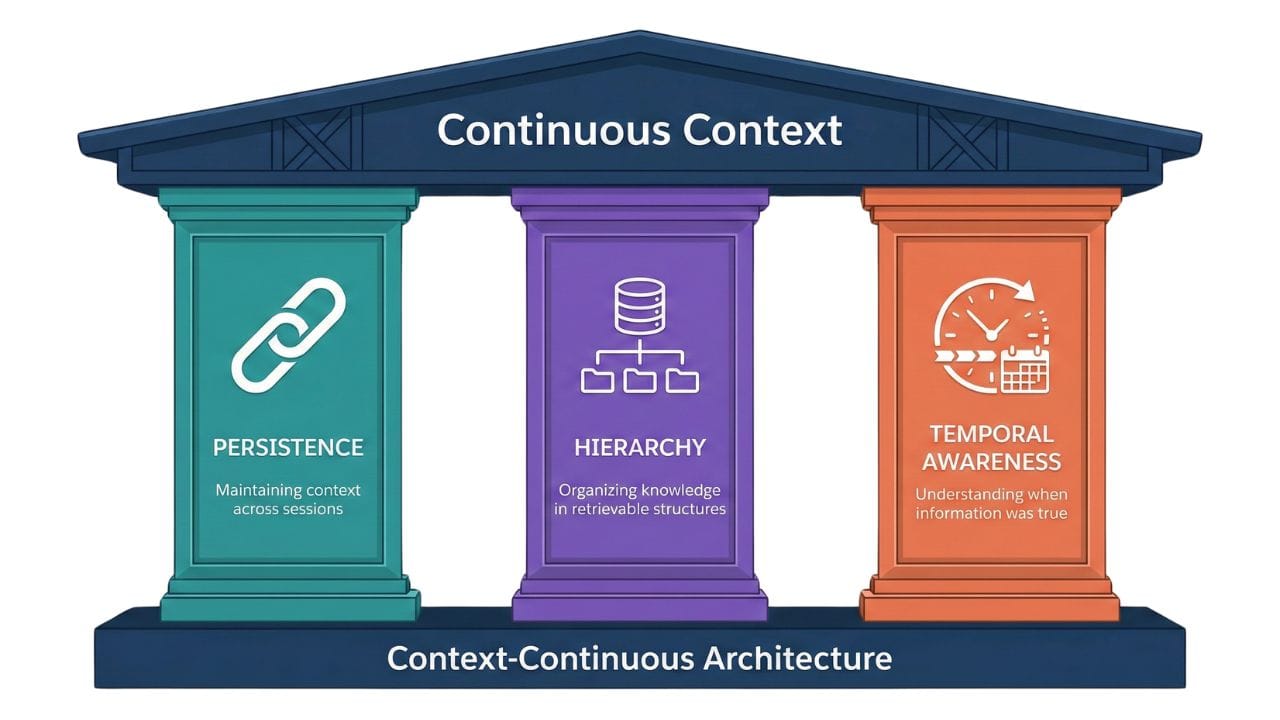
Companies using these layered approaches see growing returns over time. One investment firm managing over $250 billion connected 12 systems that used to be separate. The result: they discovered patterns that had been completely invisible before. Not just faster answers—answers that weren't possible at all before.
Figure Out Your Own Cost
The research gives us enough data to calculate your personal cost. Here's the main formula:
Yearly Cost = Your Hourly Rate × Recovery Time × Switches per Day × Work Days
Let's use real numbers. If you make $83 per hour (the average for developers), and you have just 3 major focus breaks each day that take 23 minutes to recover from, that works out to about $250 per day or $65,000 per year.
That's not your total salary. That's just the cost of losing your place—over and over.
"Managing 5 projects at once means only 20% of your time produces real results. The other 80% is overhead."
Another model says your output drops 20% for each extra project you juggle at once. Working on 3 things means only 60% real productivity. Juggling 5 things? Just 20% actual output.
Track Your Own Numbers
Keep notes for one week:
- Count interruptions per hour
Average is 15 per hour - Count how many apps you switch between daily
Using 9 or more is considered overwhelming - Measure your longest focus block
Only 39% of workers can go 2+ hours without interruption - Calculate your daily cost
Interruptions per day × 0.4 hours × your hourly rate = daily switching cost
How You Compare
| Your Number | Average | Where It Comes From |
|---|---|---|
| Daily app switches | 1,200 | Fortune 500 study |
| Time searching across apps | 59 minutes daily | Harvard Business Review |
| Feel you must answer notifications now | 56% of workers | Gartner |
| Self-caused interruptions | 44% of all interruptions | Gloria Mark |
That last number matters. Nearly half your interruptions come from yourself. You're not just paying the switching tax—you're charging it to yourself.
What Actually Works
One careful study found something uncomfortable: experienced developers were actually 19% slower when using AI tools in complex situations.
Not faster. Slower.
The study was well-designed. The participants knew what they were doing. The AI tools were current. The problem was lost context. Developers spent so much time re-explaining things to tools that forgot everything between sessions that the "help" created more work than it saved.
This wasn't a problem with AI intelligence. It was a problem with AI memory.
The research across human brains, AI systems, and company knowledge all points the same direction: broken-up information creates real, measurable costs. Gloria Mark's 23-minute recovery compounds across 1,200 daily app switches. Microsoft's research shows AI dropping 39% without continuous context. McKinsey's data shows 80% faster decisions when information stays connected.
The money involved: $450-588 billion yearly in the U.S. alone. Individual workers losing roughly 600 hours and $4,500-50,000 per year depending on their job and pay.
What actually works comes down to three ideas:
Persistence: Keeping context across sessions. Not just remembering facts, but preserving the understanding that makes future work easier.
Structure: Organizing knowledge in ways you can actually find it. Different layers for different types of information—stories, facts, and steps.
Time Awareness: Knowing when information was true and when you learned it. The difference between "current" and "historical" matters for good decisions.
Systems built on these ideas—whether for organizing company knowledge or giving AI memory—consistently show 15-30% better results and much happier users.
Main Points
- The 23-minute rule is real and expensive: Each major interruption needs almost half an hour of recovery. With 1,200 daily app switches, you lose about 5 weeks of productive time every year.
- AI tools drop 39% in quality during longer conversations—even the best models. No memory means poor performance.
- Too many tools multiplies everything: The average worker now uses 11 apps daily (up 83% since 2019). Each app is a wall. Each wall has a cost.
- Memory systems deliver 300%+ better satisfaction: The difference between forgetting and remembering isn't small—it changes everything.
- You can calculate the damage: $65,000/year for an average developer. 20-30% revenue lost to scattered data. $450-588 billion yearly across the U.S.
Common Questions
Q: Do I really need 23 minutes after every interruption?
The 23-minute figure is for getting back to deep, complex work. Simple tasks might need less recovery. But Gloria Mark's research shows most office work isn't simple—and most people underestimate how much focus they lose when interrupted. The harder or more creative your work, the closer you'll be to that 23-minute number.
Q: Why do AI systems get worse in longer conversations?
Microsoft's research found the reason: AI makes early guesses and commits to answers before it has all the information. When later messages add or change details, the AI has trouble backing up and starting over. It's built to finish things quickly, not to rethink and adjust—which is how most real work actually happens.
Q: How can I reduce my own switching cost?
Three approaches backed by research:
- Group similar tasks together so you switch less often,
- Build walls between deep work time and interruption time—physical or digital barriers, and
- Track your actual switching patterns for a week before trying to change them. Most people badly underestimate how often they switch.
Q: Why do memory systems work so much better?
Three reasons: they cut the time spent re-establishing context (faster), they keep detailed understanding that's hard to rebuild (better quality), and they let you spot patterns across conversations that you'd miss in separate sessions (smarter insights). The 300% satisfaction boost reflects all three benefits together.
Q: Is the $450-588 billion number trustworthy?
These figures combine several research sources with different methods—think of them as rough estimates, not exact counts. But even if the true number is half that size, losing context is one of the biggest drains on the modern economy. It gets almost no attention compared to how much damage it does.
Want to figure out your own cold start tax?
Start tracking your switches this week. The number will probably surprise you—and that's the first step toward doing something about it.