I Reverse-Engineered a $250 LinkedIn Course Using Claude. The Research Called Out Its Own Hype
Last week I almost bought a LinkedIn optimization course. The landing page was good. Really good. Professional design, compelling copy, clear promises. $250 for a system that would "transform your profile in 30 minutes" and create "passive lead generation while you sleep."

Last week I almost bought a LinkedIn optimization course.
The landing page was good. Really good. Professional design, compelling copy, clear promises. $250 for a system that would "transform your profile in 30 minutes" and create "passive lead generation while you sleep."
My credit card was halfway out of my wallet.
Then I thought: what if I could get the same insights—or better—without buying the course?
Not by pirating it. Not by finding some leaked version. But by using Claude to systematically extract what the course was promising to teach, then researching whether those promises actually held up.
Here's exactly what I did, step by step, with every output included.
The Landing Page
I started with this sales page: a LinkedIn personal branding course promising to help professionals stop feeling invisible, double their leads, and build a "24/7 lead generation machine."
The copy was hitting real pain points. I recognized them because I've felt most of them myself.
But instead of buying, I decided to reverse-engineer the value.
Step 1: Extract the Pain Points
First prompt to Claude:
Grab this landing page text [URL PROVIDED]. Then output 'I am sick of...' statements and 'I want...' statements based on the pain points and desires in the copy.
90 seconds later, I had this:
"I Am Sick Of..." Statements
I am sick of feeling invisible on LinkedIn
I am sick of posting content and getting zero traction
I am sick of watching warm leads go cold after they view my profile
I am sick of losing opportunities to competitors
I am sick of my profile looking like a résumé from 2015
I am sick of blending in with everyone else in my space
I am sick of relying on referrals and word-of-mouth alone
I am sick of being overlooked because people don't realize I'm an expert
I am sick of one-to-one outreach that doesn't scale
I am sick of wasting thousands every month in missed opportunities
I am sick of spending years testing and iterating without results"I Want..." Statements
I want to 2X my leads without spending more time
I want a high-converting LinkedIn profile in under 30 minutes
I want my profile to work as my sales page, website, and funnel all in one
I want a 24/7 lead generation machine that converts while I sleep
I want to differentiate myself from the competition
I want visibility, credibility, and a full pipeline
I want to scale by reaching thousands of potential leads every month
I want plug-and-play templates that actually work
I want the exact formula that's been proven hundreds of times
I want results without years of trial and error
Now I had the raw material. These weren't random topics—they were the exact problems the course creator identified as worth $250 to solve.
Step 2: Build a Research Prompt
Here's where most people stop. They'd take those pain points and ask Claude something vague like "how do I fix these LinkedIn problems?"
Generic question. Generic answer. Forgotten by tomorrow.
Instead, I built a specific research prompt designed to actually investigate whether the course's promises were realistic.
The Research Prompt:
Research current LinkedIn profile optimization and organic lead generation strategies that address specific professional pain points: feeling invisible, posting without traction, warm leads going cold after profile views, losing to competitors, outdated profile presentation, lack of differentiation, over-reliance on referrals, being overlooked despite expertise, unscalable outreach, and missed revenue opportunities.
I'm creating content around solutions that deliver: doubled lead flow without increased time investment, rapid profile transformation (under 30 minutes), profiles that function as integrated sales pages, passive lead generation systems, clear competitive differentiation, combined visibility-credibility-pipeline building, scalable reach to thousands monthly, proven plug-and-play templates, and results without extended trial periods.
Focus on developments from the past 12 months, prioritizing practitioner sources (LinkedIn coaches, B2B marketers, sales professionals) over academic theory. I need specific tactics, frameworks, and measurable outcomes—not general advice.
If certain claims (like '2X leads' or '30-minute transformations') lack supporting data or conflict across sources, note that rather than accepting them at face value. Cite sources where possible.
Notice the last paragraph. I Claude explicitly was told to fact-check the marketing claims, not just find information that confirmed them.
This is the difference between research and confirmation bias.
Step 3: The Research Results
Claude came back with a comprehensive analysis. And this is where things got interesting.
The research didn't just provide LinkedIn tips. It systematically evaluated whether the course's specific promises were supported by evidence.
Here's what held up:
Profile optimization does produce real results. Verified case studies show consistent patterns—one management consultant saw connection acceptance rates double over 6 weeks and generated $85,000 in closed projects over four months. A freelance writer increased profile views from ~10/month to 90+/month over three months.
Comments boost post reach 15x more than likes. This finding appeared across multiple algorithm studies. Spending 15-20 minutes daily on thoughtful commenting may actually outperform equivalent time creating original content.
Carousels dominate current format performance. Buffer's controlled experiment found carousels generated 278% more engagement than video and 596% more than text-only posts.
LinkedIn is legitimately effective for B2B. The platform is 277% more effective for B2B lead generation than Facebook and Twitter combined, and leads convert at 3x the rate.
Here's what got debunked:
"Transform your profile in 30 minutes" — Every credible case study shows meaningful results take 6-8 weeks minimum. You can update profile sections in 30 minutes, but generating measurable business results requires sustained effort. The algorithm itself tests posts with small audiences first and extends reach gradually. It's designed against rapid transformation.
"Passive lead generation while you sleep" — LinkedIn explicitly deprioritizes inactive profiles. Without posting and engaging, visibility disappears. Even "passive" lead gen forms require active ad spend ($8-15 CPC) and ongoing management. The word "passive" is doing a lot of heavy lifting in that marketing copy.
"Double your leads" — Technically possible, but depends entirely on your baseline. Going from 2 leads to 4 leads is "doubling." The average cold outreach lead rate is 0.25-1%, meaning 99%+ of outreach doesn't convert. The research found 68% of B2B businesses still struggle with lead generation on LinkedIn despite optimization efforts.
"Reach thousands monthly with organic content" — This was more accurate in 2022-2023. Current algorithm changes specifically prevent viral content and prioritize niche relevance over mass reach. Organic reach dropped 34% in 2024-2025. Still possible for skilled practitioners, but requires expert-level content strategy and consistent effort—not templates.
"Plug-and-play templates that work for everyone" — The algorithm now evaluates creator expertise and audience relevance. Templates provide starting frameworks, not results. A headline template that works for a sales coach won't automatically work for a software consultant. Context matters more than formulas.
Here's the Actual Results (Markdown Format):
Step 4: What I Actually Learned
Here's the thing: the research gave me more honest, nuanced information than the course probably delivers.
Not because the course creator is lying. They're likely teaching what worked for them. But sales pages are optimized to sell, not to set realistic expectations.
The research showed me:
What actually moves the needle:
- Strategic commenting (15+ words, on relevant thought leaders' posts) — highest verified ROI activity
- Profile optimization focused on the first 200 characters of your About section
- Carousel/document posts for content creation
- Featured section that drives traffic OFF LinkedIn to assets you control
- Consistent posting 2-5x weekly over 6-8 weeks minimum
What the realistic timeline looks like:
- Typical results: 50-150% profile view increases over 6-8 weeks
- Exceptional performers hit 300%+ but represent the high end
- Meaningful lead generation results: 3-6 months of consistent effort
What the benchmarks actually are:
- Overall LinkedIn engagement rate: 5.20% by impressions
- InMail response rates: 10-25% (versus cold email's 1-5%)
- Connection requests with personalized notes: 9.36% response rate
This is the information I needed to set realistic expectations and build a real strategy—not chase promises that were never going to materialize in the timeframe suggested.
Step 5: Turn It Into a Reusable System
The last step was converting all of this into Claude Project instructions.
Now I have a LinkedIn strategy project where every conversation starts with:
- My specific context and goals
- The vetted research findings
- Realistic benchmarks and timelines
- The tactics that actually have evidence behind them
When I ask for help with a LinkedIn post, Claude doesn't give me generic advice. It gives me recommendations grounded in what the research showed actually works.
One-time build. Permanent leverage.
The Real ROI
Time spent: About 45 minutes total
What I got:
- Extracted pain points I can use for my own content
- A research prompt template I can reuse for any topic
- Comprehensive, fact-checked information on LinkedIn optimization
- Realistic expectations instead of marketing hype
- A reusable Claude Project for ongoing LinkedIn strategy
What I saved:
- $250
- The frustration of expecting 30-minute results and getting 8-week timelines
- Hours of trial-and-error testing claims that don't hold up
The course might still be valuable—I don't know what's in it. But I got what I needed without it. And I got something the course probably doesn't include: an honest assessment of what's realistic.
The Bigger Point
This isn't really about saving $250 on a LinkedIn course.
It's about a different way of using AI.
Most people ask Claude random questions and get random answers. They close the tab and lose whatever value they got.
What I did instead:
- Started with source material that already existed
- Extracted the structure before asking for answers
- Built a specific research prompt with fact-checking instructions
- Turned the results into a reusable system
Each step builds on the last. The output of step one becomes the input for step two. The final product isn't an answer—it's infrastructure.
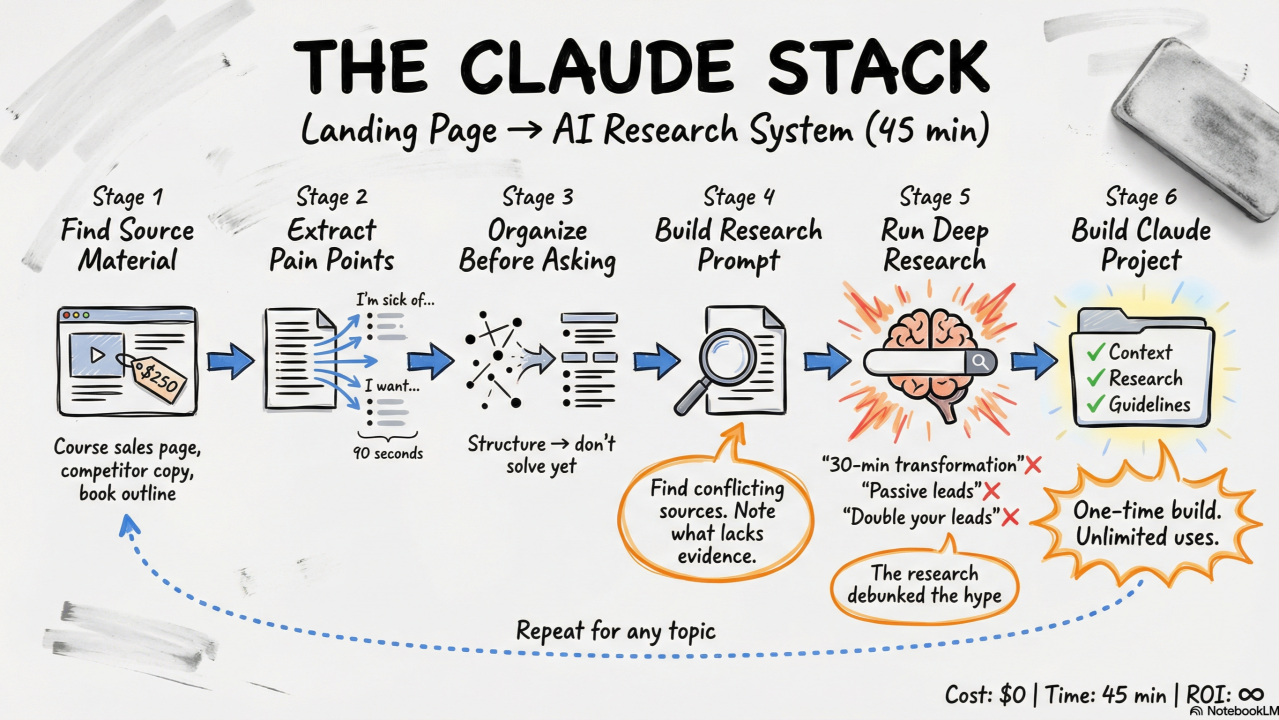
I call it the Claude Stack.
You can use it on any topic where someone's selling expertise:
- Find a course, book, or coaching program sales page
- Extract the pain points and promises
- Research whether those promises hold up
- Build project instructions from what's actually supported
Sometimes you'll find the course is worth buying. Sometimes you'll find you can get 80% of the value through research. Either way, you'll make an informed decision instead of being sold.
Want This Exact System? Build It in 5 Minutes.
I'm giving you the project instructions and the research document. Here's exactly how to set it up:
Step 1: Create a New Claude Project
In Claude, click Projects → New Project
Step 2: Name and Describe It
Name: Marketing » Social Media » LinkedIn Lead Generation System
Description: This project creates a comprehensive, ongoing LinkedIn lead generation system built on evidence-backed tactics with realistic timelines and measurable deliverables targeting B2B decision-makers.
Step 3: Paste the Project Instructions
Copy the project instructions and paste them into the Project Instructions field. These tell Claude how to behave in every conversation—what to prioritize, what benchmarks to reference, what tactics have actual evidence behind them.
Step 4: Add the Research as Project Knowledge
Paste the full research document underneath the project instructions in the Project Knowledge section. This gives Claude the data, sources, and findings to draw from. Not generic LinkedIn advice—the specific benchmarks and debunked claims from this investigation.
Here is everything you need to paste:
Marketing » Social Media » LinkedIn Lead Generation System
Claude Project Instructions Framework
1. Purpose & Scope
Project Goal:
Create a comprehensive, ongoing LinkedIn lead generation system built on evidence-backed tactics with realistic timelines and measurable deliverables targeting B2B decision-makers.Boundaries:
- Commenting strategy (highest-leverage activity)
- Carousel/document content creation
- Profile optimization
- Realistic 6-8 week implementation timelines
- Target audience: Decision-makers at companies with 10-50 employees, SaaS founders, business professionals aged 35-50
Out of Scope:
- Unverified "hype" tactics lacking research support
- Automation tools that violate LinkedIn ToS
- Promises of rapid or passive results
2. Role & Perspective
Claude's Role:
Strategic LinkedIn consultant who references research data to guide decisions. Provide tactical recommendations grounded in verified benchmarks (van der Blom's Algorithm Insights, Buffer experiments, SocialInsider data, LinkedIn's own research).Target Audience:
- Primary: To implement tactics for LinkedIn presence
- Secondary: LinkedIn user-facing materials for LinkedIn optimization guidance
3. Structure & Formatting
Preferred Output Style:
Action-oriented frameworks that lead with specific tactics. Outputs should be ready-to-implement rather than theoretical.Formatting Rules:
- Lead with the tactic/action, not the explanation
- Use tables for benchmarks and comparisons
- Bullet points for checklists and quick-reference items
- Include concrete examples: comment templates, headline formulas, content calendars
- Markdown format for all outputs (no .docx)
Example Output Types:
- Weekly commenting targets with prospect lists
- Carousel templates following SLAY framework
- Headline formulas with fill-in-the-blank structure
- Content calendars with posting frequency and format mix
4. Domain Knowledge & Priorities
Core Methods/Frameworks:
Framework Source Application Commenting Strategy (15x multiplier) van der Blom Algorithm Insights 2024 Daily engagement activity SLAY Content Framework Lara Acosta Post structure: Story-Lesson-Actionable-You "I help X achieve Y through Z" Justin Welsh, Jasmin Alić Headline optimization Carousel/Document Posts Buffer, SocialInsider Primary content format (6-10 slides) Hook + Rehook Jasmin Alić First 3 lines optimization Why These Matter:
Evidence-based approach rejects tactics that lack independent verification. The research shows 98% of users experienced reach decline in 2024-2025—only verified tactics warrant investment.Key Priorities (in order):
- ROI per hour invested
- Commenting as highest-leverage activity (15-20 min/day)
- Content quality over posting frequency
- Conversion-focused Featured section (drive traffic off LinkedIn)
- Realistic timeline expectations (6-8 weeks minimum)
5. Accuracy & Depth
Fact-Checking Expectations:
Strict evidence standards. All recommendations must trace to research data:
- van der Blom: Algorithm mechanics, engagement multipliers
- Buffer: Format performance (carousels 278% > video)
- SocialInsider: Engagement rate benchmarks (5.20% average)
- LinkedIn official data: Headshot impact (14x), InMail response rates
Confidence Flagging:
Always distinguish:
- High-confidence (multiple independent sources): Commenting > posting, carousels dominate, first-person writing 3-5x better
- Medium-confidence (limited but credible data): SLAY framework, Tuesday-Thursday timing, 6-10 slide optimal length
- Low-confidence (marketing claims): Specific growth guarantees, "secret" hacks
Depth of Analysis:
Match depth to decision complexity:
- Quick tactical questions → Concise, direct answers
- Strategy questions → Full analysis with supporting data and benchmarks
6. Efficiency & Flexibility
Conciseness vs Detail:
Lead with the action, support with evidence only if needed. Structure responses:
- What to do (specific tactic)
- Why it works (brief evidence reference)
- How to implement (concrete example)
Adaptability Rules:
Context Output Style Personal implementation notes Raw, direct, minimal formatting Client-facing materials Polished frameworks, professional presentation Quick questions Shortest useful answer Strategy sessions Full context with alternatives Time Respect:
Front-load value. No preamble. Skip "I hope this helps" and similar phrases.
7. Style & Tone
Tone of Voice:
- Direct practitioner voice
- No fluff or motivational content
- No "LinkedIn guru" energy
- Practical and slightly skeptical of hype
- Focused on what actually works
Brand Alignment:
Match Weblytica voice: educator positioning, not tutorial creator. Emphasis on practical business applications over generic advice.Consistency Rules:
- Always distinguish "verified by data" vs "commonly recommended"
- Maintain professionalism while staying authentic
- Use specific numbers and benchmarks rather than vague claims
- Acknowledge algorithm changes and their implications
Avoid:
- Overpromising results
- Generic LinkedIn advice
- Emotional/motivational language
- Third-person corporate speak
8. Iteration & Re-use
Reusability:
Outputs should be modular and template-driven:
- Adaptable for different client industries/niches
- Scalable content themes that avoid repetition
- Transferable frameworks (e.g., SLAY applies across topics)
Version Notes:
Flag when tactics may need updating due to algorithm changes. Current framework based on June 2023-2024 algorithm update and 2024-2025 benchmark data.Refinement Loop:
Track and revisit:
- Engagement rates vs. benchmarks (5.20% overall, 6.10% documents)
- Comment-to-connection conversion rates
- Profile view increases (target: 50-150% over 6-8 weeks)
- Lead generation from Featured section CTAs
Update Triggers:
- LinkedIn announces algorithm changes
- Benchmark data older than 12 months
- Personal results deviate significantly from research expectations
Quick Reference: Key Benchmarks
Metric Benchmark Source Overall engagement rate 5.20% SocialInsider Document post engagement 6.10% SocialInsider Comments vs likes impact 15x more reach van der Blom Carousel vs video engagement 278% higher Buffer InMail response rate 10-25% Optimal message length <400 characters (+22%) Optimal carousel length 6-10 slides Industry consensus Posting frequency 2-5x/week Buffer Results timeline 6-8 weeks minimum Case study consensus
High-Confidence Tactics Checklist
- [ ] Daily commenting (15-20 min, 15+ word comments on relevant thought leaders)
- [ ] Carousel/document posts as primary format
- [ ] Professional headshot (14x visibility increase)
- [ ] First-person writing in all content
- [ ] First 200 characters of About section optimized for mobile
- [ ] Featured section drives traffic OFF LinkedIn
- [ ] "I help X achieve Y through Z" headline structure
- [ ] SLAY framework for post structure
- [ ] 2-5 posts per week, mixed formats
- [ ] Short InMails (<400 characters) for outreach
LinkedIn Lead Generation in 2025: What Actually Works vs. Marketing Hype (Deep Research)
The reality check B2B professionals need: LinkedIn optimization can meaningfully improve lead generation—but most marketed claims are significantly oversold. Organic reach dropped 34% in 2024-2025, making the platform harder to crack just as everyone rushed in. The evidence shows profile optimization typically yields 50-150% increases in visibility over 6-8 weeks (not doubling leads overnight), while commenting strategically provides the single highest-verified ROI activity. Below is what practitioners, data, and case studies actually support versus what's selection bias dressed as strategy.
The algorithmic reality has shifted against creators
LinkedIn fundamentally changed its algorithm in June 2023-2024, and the implications undercut many popular optimization strategies. The platform now explicitly deprioritizes viral content, favoring "knowledge and advice" shared within professional niches over broad-reach engagement bait. AuthoredUp's analysis of 621,833 posts found reach down for 98% of users compared to the prior year, with median document post reach falling 25%.
Three algorithm factors LinkedIn has officially confirmed drive visibility: relevance to specific audiences, expertise evaluated through your profile and content history, and meaningful engagement (comments from genuinely interested people). Notably, LinkedIn now checks whether you're writing about topics matching your stated professional background—generic content from accounts lacking demonstrated expertise gets throttled. The "golden hour" after posting determines trajectory: posts need early engagement to escape the spam filter that catches roughly half of all content.
Company pages have been decimated—organic company content now represents just 2% of feeds (down from 7% in 2021), while personal profiles receive 10-30x more reach. This explains why employee advocacy and personal brand strategies have become non-negotiable for B2B visibility.
Profile optimization works, but transformation timelines are fiction
The evidence supports that profile optimization produces real results—just not the "30-minute transformation" claims saturating LinkedIn courses. Verified case studies show consistent patterns:
A management consultant saw connection acceptance rates double in 6 weeks and generated $85,000 in closed projects over four months through structured profile optimization. A freelance writer increased profile views from ~10/month to 90+/month (800% increase) over three months, generating 15-20 client inquiries monthly. These represent the high end. Typical results across studies show 50-150% profile view increases, with exceptional performers hitting 300%+.
What the data-backed profile changes look like: Professional headshots increase visibility 14x (LinkedIn's own data), adding location boosts profile views up to 19x, and profiles with 5+ pieces of rich media receive 21x more views. The first 200 characters of your About section display before truncation on mobile—these must immediately communicate who you help and what problem you solve. First-person writing ("I" and "my") generates 3-5x higher engagement than third-person corporate speak.
The headline frameworks with broadest practitioner consensus follow the "I help X achieve Y through Z" structure, though variations exist. Justin Welsh (750K+ followers, $12M+ revenue) emphasizes value statements: who specifically you help, what specifically you help them do, and expected outcomes. Jasmin Alić advocates storytelling hooks: "I tell stories that [evoke emotion] in [target audience]." The 220-character limit (with first 60 most critical for search visibility) demands precision over cleverness.
The engagement hierarchy that actually moves metrics
Across algorithm studies and practitioner experience, one finding stands out with unusual consistency: comments boost post reach 15x more than likes. Richard van der Blom's Algorithm Insights 2024 Report (analyzing 1.5M+ posts across 34,000 profiles) confirms this multiplier, with comments also outperforming shares by 5x and instant reposts by 2.5x. Comments exceeding 15 words are weighted higher by the algorithm than brief reactions.
This creates a strategic imperative: spending 15-20 minutes daily on thoughtful commenting—particularly on posts from key opinion leaders in your space—may outperform equivalent time spent creating original content. The 80/20 rule cited across practitioners: 80% of LinkedIn success comes from engaging with others' content, 20% from posting. The optimal comment structure adds a relevant observation, connects to personal experience, and asks an open-ended question.
For original content, carousels (document posts) dominate current format performance. Buffer's controlled experiment found carousels generated 278% more engagement than video and 596% more than text-only posts. SocialInsider's analysis of 1 million posts shows document posts averaging 6.10% engagement rate versus 4.00% for text and 4.40% for polls. Optimal carousel length: 6-10 slides; fewer than 5 reduces reach by 35%.
The content framework with strongest practitioner consensus is Lara Acosta's SLAY method: Story (personal narrative creating uniqueness), Lesson (key takeaway), Actionable advice (specific steps), and You (turning it to the reader with a question or CTA). Posts must deliver complete value in the first three lines visible in feeds—Jasmin Alić's "Hook + Rehook" framework emphasizes that the truncation point is where most content dies.
The claims audit reveals systematic overselling
Investigating the specific claims circulating in LinkedIn marketing reveals a pattern of selection bias and compressed timelines:
"Double your leads" is partially true with significant caveats. LinkedIn is 277% more effective for B2B lead generation than Facebook/Twitter combined (HubSpot data across 5,000 businesses), and leads convert at 3x the rate of other platforms. However, 68% of B2B businesses still struggle with lead generation on LinkedIn. The average cold outreach lead rate is 0.25-1%—meaning 99%+ of outreach doesn't convert. Connection request limits dropped from 100/day to 100/week in 2022, reducing outreach capacity 7x. "Doubling leads" depends entirely on your baseline; going from 2 to 4 is mathematically accurate but practically meaningless.
"Transform your profile in 30 minutes" conflates activity with outcomes. You can update profile sections in 30 minutes, but generating measurable business results requires 6-8 weeks minimum across all credible case studies. The algorithm itself tests posts with small audiences first and extends reach gradually—it's designed against rapid transformations.
"Passive lead generation from your profile" is mostly hype. The algorithm rewards active engagement; LinkedIn explicitly deprioritizes inactive profiles. Without posting and engaging, visibility disappears. Even "passive" lead gen forms require active ad spend ($8-15 CPC) and ongoing management.
"Reach thousands monthly with organic content" was more accurate in 2022-2023. Current algorithm changes specifically prevent viral content and prioritize niche relevance over mass reach. It remains possible for skilled practitioners but requires expert-level content strategy and consistent effort.
"Plug-and-play templates that work for everyone" ignores that the algorithm now evaluates creator expertise and audience relevance—factors templates cannot replicate. Templates provide starting frameworks, not results.
Claim Verdict Evidence Quality Double your leads Partially true (with caveats) Strong data, weak on typical vs. exceptional 30-minute transformation Hype Contradicted by all case study timelines Passive lead generation Mostly hype Contradicted by algorithm mechanics Reach thousands organically Partially true (declining) Strong data showing 34% reach decline Comment strategy 10X visibility Partially true Strongest evidence (15x vs. likes verified) Plug-and-play templates Hype Contradicted by algorithm expertise signals Data-backed benchmarks for realistic planning
Setting expectations against actual data prevents both disappointment and wasted effort:
Engagement rate benchmarks: Overall LinkedIn engagement rate by impressions is 5.20% (SocialInsider mid-2025). Multi-image posts lead at 6.60%, documents at 6.10%, video at 5.60%. Smaller accounts (<5K followers) see ~6% engagement rates; larger accounts (100K+) drop to ~3%. Average engagement rate per follower is just 0.41% (Rival IQ).
Outreach response rates: InMails average 10-25% response rates versus cold email's 1-5%. LinkedIn's own data (tens of millions of InMails analyzed) shows messages under 400 characters receive 22% higher response rates than average. Industry variation is massive: legal/professional services see 10.42% response rates while software/SaaS averages 4.77%. Connection requests with personalized notes achieve 9.36% response versus 5.44% without.
Posting frequency and timing: The consensus points to 2-5 posts per week as optimal (Buffer analysis of 2M+ posts). Brands average 3.3 posts weekly. Best days cluster around Tuesday-Thursday, with Thursday typically strongest. Best times fall between 9 AM-2 PM local time, though audience-specific variation exists. Consecutive same-format posts reduce reach—mixing content types is algorithmically favored.
Realistic timelines: Meaningful profile optimization results take 6-8 weeks. The highest-performing case studies span 3-6 months. No credible source supports instant or effortless results.
The Featured section strategy most practitioners miss
Justin Welsh's observation on Featured sections challenges common practice: featuring your best LinkedIn posts creates circular traffic keeping visitors on platform rather than converting them. Instead, the Featured section should drive visitors off LinkedIn to assets you control—newsletter signups, Calendly booking links, lead magnets, or product pages. Premium members can add custom CTA buttons ("Visit my website," "Request services") enhancing this conversion path.
The recommended structure follows a buying journey: free resource → low-ticket product → high-ticket service, or simply a single clear offer with direct CTA. Visual cohesion matters—using on-brand cover images for each featured item reinforces professionalism. Profiles with Featured content see 30% longer viewing time, but the goal is conversion, not extended profile visits.
What the best evidence actually supports
Synthesizing across LinkedIn's official data, practitioner consensus, B2B marketing benchmarks, and verified case studies, these strategies have the strongest support:
High-confidence tactics (verified by multiple independent sources):
- Commenting strategically produces better ROI than equivalent posting time
- Carousels/documents significantly outperform other content formats
- Professional photos, complete profiles, and keyword-optimized headlines improve discoverability
- Personal profiles dramatically outperform company pages for organic reach
- First-person writing outperforms third-person by 3-5x
- Short InMails (<400 characters) outperform long ones by 22%
Medium-confidence tactics (supported by limited but credible data):
- The "I help X achieve Y through Z" headline formula
- SLAY content framework (Story-Lesson-Actionable-You)
- Posting Tuesday-Thursday mornings
- 6-10 slide carousels as optimal length
Low-confidence tactics (primarily marketing claims lacking independent verification):
- Specific follower growth guarantees
- Revenue claims from course sellers
- "Secret" algorithm hacks
- Automation tool success rates (also carry ToS risk)
The honest bottom line: LinkedIn optimization is legitimate and can produce meaningful B2B results, but marketing systematically exaggerates outcomes, compresses timelines, and ignores required effort. Success demands consistent, quality-focused effort over months—not templates, hacks, or 30-minute transformations. The 2024-2025 algorithm changes have made organic growth harder precisely as competition intensified. Those who succeed treat LinkedIn as a long-term relationship-building platform rather than a quick-win lead machine.
Conclusion
The practitioner landscape reveals a gap between what's sold and what's supported. Comments matter more than posts, carousels dominate engagement metrics, and profile optimization produces real but modest results over realistic timelines. The "doubled leads" and "passive income" narratives exploit selection bias—showcasing exceptional outcomes while obscuring the 68% of B2B businesses still struggling.
For professionals feeling invisible despite expertise, the evidence points toward strategic commenting (15+ words, on relevant thought leaders' posts, 15-20 minutes daily) as the highest-leverage activity. Profile optimization should prioritize the first 200 characters of your About section, a results-focused headline, and Featured section links driving traffic off-platform. Content creation should emphasize document posts and the SLAY framework, with 2-5 posts weekly maintaining algorithmic favor.
The uncomfortable truth: LinkedIn works for B2B lead generation, but not quickly, passively, or via templates. Results require 6-8 weeks minimum of consistent effort, with exceptional outcomes taking 3-6 months. Anyone promising faster should be met with the same skepticism this research applies to their claims.
Step 5: Save
That's it. Your custom project is ready to use.
Every conversation in that project now starts with context already loaded. Ask for help with your headline, content strategy, or posting schedule—Claude responds with recommendations grounded in what the research actually supports.
No more generic advice. No more starting from zero. Actual tactics with actual benchmarks.
The Method Matters More Than This Example
You can use this same process—extract, organize, research, systematize—for any topic where someone's selling expertise:
- Find a course or coaching program sales page
- Extract the pain points and promises
- Build a research prompt that fact-checks the claims
- Turn the findings into Claude Project instructions
Sometimes you'll discover the course is worth buying. Sometimes you'll get 80% of the value through research alone. Either way, you make an informed decision instead of being sold.
That's the Claude Stack.
45 minutes to build. Unlimited uses after.
The irony isn't lost on me that I'm posting LinkedIn content about how LinkedIn marketing is oversold. But that's kind of the point: the best LinkedIn content is honest, useful, and doesn't promise transformation in 30 minutes.
It promises value. Then delivers it.
Like this article, hopefully.