An AI Agency Told Other Agencies to “Take Advantage of the Ignorance Arbitrage.” I Have Questions.
I was watching a YouTube interview a few weeks ago. Standard AI agency content — the kind where someone in a polo shirt explains why your…

I was watching a YouTube interview a few weeks ago. Standard AI agency content — the kind where someone in a polo shirt explains why your business is leaving money on the table. Background music that sounds like it was licensed from “Corporate Inspiration Vol. 3.” You know the vibe. You’ve skipped these ads.
Then the guest said something that made me set down my coffee.
“I’m telling all AI agencies to take advantage of the Ignorance Arbitrage right now before people learn about AI themselves.”
I didn’t know the term. So I did what any reasonable person does when they encounter unfamiliar jargon: I nodded like I understood and moved on with my day. Then I Googled it three days later at 11 PM because my brain is a chaos goblin that refuses to let things go.
Turns out, ignorance arbitrage is beautifully simple. It means charging someone a premium price for something that costs you almost nothing — because they don’t know what it actually costs.
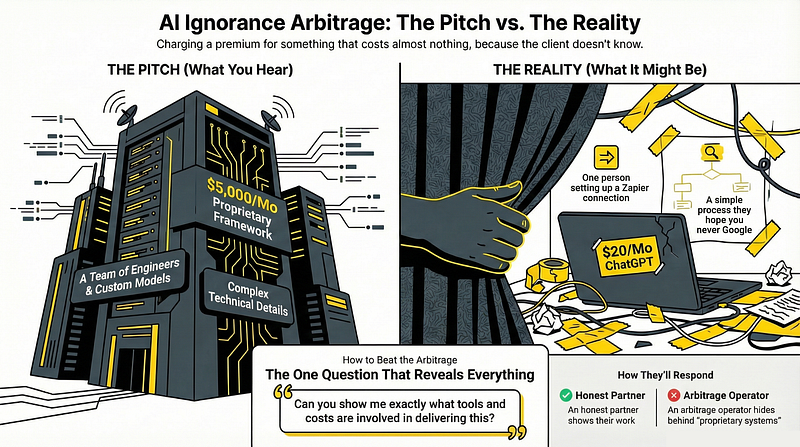
In the AI agency world, this looks like: charge a client $5,000 a month for “AI-powered customer service automation,” then fulfill it with a $100 ChatGPT subscription and a Zapier account you set up during lunch. The client doesn’t know. The client CAN’T know, because you’ve made sure everything sounds complicated enough that they’d never think to look behind the curtain.
The arbitrage isn’t in the AI. It’s in the ignorance.
And this person said it out loud. On camera. As advice.
I have questions. Mostly rhetorical. Mostly angry.
The Part Where I Do Math (Badly, But With Feeling)
Let’s play a fun game called “What Does This Actually Cost?”
Scenario: An AI agency sells you a “custom AI chatbot solution” for $10,000 setup plus $2,000/month ongoing.
What you imagine: A team of engineers, custom model training, proprietary technology, servers humming in a climate-controlled room somewhere.
What it might actually be: A ChatGPT API integration ($100–300/month based on usage), a no-code chatbot builder ($50–200/month), and about four hours of someone’s time copy-pasting your website’s FAQ into a prompt.
I’m not saying all AI agencies operate this way. Some do genuinely custom work. Some build real infrastructure. Some are worth every penny.
But some — and apparently enough that this guy felt comfortable giving advice about it on YouTube — are running a margin that would make a mattress store jealous.
(If you’re under 35, mattress stores were these places that perpetually had “GOING OUT OF BUSINESS” sales but never actually went out of business.)
“Before People Learn About AI Themselves”
This is the part of the quote that really got me.
He didn’t say “before AI gets commoditized.” He didn’t say “before the market matures.” He said “before people learn about AI themselves.”
The quiet part, out loud: the entire business model depends on clients staying ignorant. Not just now — forever, ideally. Or at least until the retainer contract auto-renews a few more times.
This is why these agencies:
Never teach you how anything works. “You don’t need to worry about the technical details” isn’t customer service. It’s a curtain. And there’s a very nervous man behind it hoping you don’t look.
Use jargon like it’s a defensive weapon. If I had a dollar for every time an agency proposal used “proprietary AI framework” to describe “we made a custom GPT,” I could afford to buy one of their packages. (I wouldn’t. But I could.)
Structure contracts around dependency. Monthly retainers. Hosting on their servers. Logins they control. Systems that mysteriously require their ongoing involvement. It’s not support — it’s a lock-in strategy wearing a helpful smile.
Actively discourage questions. The more you understand, the less you need them. The less you need them, the less you pay them. Every answered question is revenue walking out the door. So they just… don’t answer questions.
The ignorance isn’t a bug. It’s the product.
What You’re Actually Paying For (A Dramatic Reveal)
Here’s a partial list of things that sound expensive but often aren’t:
- “AI-powered content generation” — Could be a $20/month ChatGPT Plus subscription
- “Automated email sequences with AI personalization” — Could be Mailchimp plus a prompt template
- “Custom AI assistant for your team” — Could be a Claude Project that takes 45 minutes to set up
- “Intelligent document processing” — Could be a Make.com scenario with a PDF parser
I’m not saying these things have no value. Implementation matters. Integration matters. Knowing which tools to use and how to connect them — that matters.
But there’s a difference between “I’m charging you for my expertise in building this well” and “I’m charging you for my confidence that you’ll never Google this.”
One is consulting. The other is a magic trick where the magician gets really nervous if you ask to see the hat.
The Opposite of Ignorance Arbitrage Is… Uncomfortably Honest Pricing
I started my career as a non-formal educator for the University of Arkansas. Not in classrooms — in fields, with farmers. Teaching people how to improve their operations using knowledge they could own and apply themselves. Nobody paid me a retainer to keep their crops growing. That would’ve been weird. And possibly illegal. (I never checked, but it feels like it should be illegal.)
I still do the same thing. The subject changed from agriculture to automation, and now to AI. The mission didn’t.
When I work with clients, I show them exactly what we’re building. I explain what it costs. I teach them how to maintain it themselves. And yes, I tell them when a $20/month tool will solve their problem — even when I could’ve charged them $2,000 to “implement an AI solution” that’s just that tool with a bow on it.
(This is, admittedly, a terrible way to maximize revenue. If there’s an Ignorance Arbitrage, I’m running whatever the opposite is. Transparency Arbitrage? Honesty Discount? ‘Business Model That Makes My Accountant Sigh Audibly’?)
But here’s what happens when you actually teach people: they trust you. They refer you. They come back with bigger problems because they know you won’t oversell the small ones.
One of my favorite moments: a client I’d worked with for two years told me, “You’ve taught me everything I need to know. If I get stuck, I’ll call you, but I don’t think I need you anymore.”
That’s not lost recurring revenue. That’s graduation. That’s the whole point.
The ignorance arbitrage crowd would see that as a failure.
I see it as the only metric that actually matters.
The Window Is Closing (And I’m Not Sad About It)
Here’s the thing YouTube Guy got right: the window IS closing. Business owners are learning. They’re discovering that ChatGPT exists. They’re realizing that “AI-powered” often means “uses an API that costs pennies per request.” They’re starting to ask uncomfortable questions like “wait, how much does this actually cost you?”
The agencies built on ignorance arbitrage are going to have a rough couple of years. Not because AI is getting worse — because their clients are getting smarter. And a business model that requires customer ignorance has an expiration date printed right on it.
Meanwhile, those of us who teach? Who show our work? Who would rather make a reasonable margin on honest value than a ridiculous margin on confusion?
We’re going to be fine. Better than fine.
Because it turns out “I’ll tell you exactly what this costs and teach you to do it yourself” is a competitive advantage when everyone else is desperately hoping you never learn to Google.
The One Question That Reveals Everything
If you’re evaluating an AI service — any AI service — ask this:
“Can you show me exactly what tools and costs are involved in delivering this?”
Watch their face. The good ones will open a screen share before you finish the sentence. They’ll walk you through the stack. They’ll show you the $47/month in subscriptions that power the whole thing. They’ll explain why their fee on top of that is worth it (and it often is — expertise matters).
The ignorance arbitrage operators? They’ll pivot. They’ll talk about “proprietary systems.” They’ll assure you that you don’t need to worry about the details. They’ll use the word “seamless” at least three times.
The details are where the margin lives. If they won’t show you the details, you ARE the margin.
The ignorance arbitrage window is closing. Make sure you’re not the last one standing in it when it shuts.
Andy O’Neil teaches business owners to build AI & automation systems they actually understand — including what they cost, how they work, and how to maintain them without paying someone $2,000/month to restart a Zapier integration. He’s conducted 700+ co-building sessions and remains committed to the radical business strategy of “telling people the truth about pricing.” Connect with him on LinkedIn if you want more of…this. Whatever this is.